


High quality dental services
- Aesthetic dentistry
- Endodontics
- Intraoral splints
- Dental implants
- Periodontology
- Preventive dentistry
- Prosthodontics
- Oral and Maxillofacial Surgery
Aesthetic dentistry

1. Composite resin fillings
2. Composite resin veneers
3. Porcelain veneers
4. Inlays-Onlays
5. All-ceramic crowns
6. Bleaching
1. The well-known white filling. Today it is widely used by the general dentist in relation to amalgam (metal filling) due to the fact that it has excellent aesthetic performance like natural teeth. Other key advantages of using composite resin are: avoid the use of mercury contained in amalgam, less tooth substance is removed during the preparation of a tooth, easily repaired in case any part of the filling comes off.
Disadvantages of composite resin are:
In decayed teeth where the preparation cavity of the tooth ends below the gum line, due to the moisture contained in this area the proper polymerization of the composite resin is not achieved, resulting in microbial penetration at the point of contact of the material with the tooth and presence of secondary caries. Despite the disadvantages, the continuous development of composite resin materials and welding techniques has the effect of greatly reducing the use of amalgam.
2. Composite resin veneers have a highly aesthetic performance because their design in the laboratory has the effect of imitating the shape and color of natural teeth, which in an extended form restore the patient’s smile.
The main disadvantages of composite resin veneers are:
a) The reduced resistance to the chewing forces, as a result of which they break more easily than the natural teeth and need restoration after about five years.
b) The porosity of the material tends to absorb pigments which gradually changes its color.
3. Porcelain veneers have an excellent aesthetic effect and higher cost compared to those of composite resin. The general dentist in collaboration with the dental laboratory must achieve the best result for the patient’s smile.
4. Inlays and Onlays are the white fillings of composite resin or porcelain, which are made in the dental laboratory after the preparation of the tooth and the taking of an impression. The adjustment and welding is done in a second session. They have an advantage over composite resin fillings in that:
a) They have a better shape and color due to their construction in the laboratory.
b) Their adhesion to the tooth takes place in a completely dry environment and in the absence of polymerization shrinkage, thus eliminating the risk of microbial penetration and caries in the area.
c) They are suitable for posterior teeth and in cases of extensive loss of tooth substance.
5. All-ceramic crowns are constructions of complete restoration of the tooth in case of great loss of dental substance, with materials of high aesthetics (zirconium) and are today’s standard choice of restoration for anterior and posterior crowns. Their great advantage is that they give absolute aesthetic harmony between the neck of the tooth and the crown exactly at the point of contact with the gums. This eliminates the chronic problem that metal porcelain hoops show over the years, that of the existence of the black cervical line at the gingival contact point, especially in the anterior aesthetic zone of the smile.

6. Teeth whitening is a common, safe method of cosmetic intervention by applying a special whitening material in the form of gel which breaks down the pigments on the outside of the tooth without damaging the enamel, so that the final result contributes to an
aesthetic smile.
Teeth whitening methods
a) Bleaching at home. We place the gel (carbamide peroxide or hydrogen peroxide) in individual special splints, and then the patient places them daily, for 1-2 hours – that is how long the action of the material lasts – and for about 4 days. The advantages of whitening at home is that the procedure is very simple and costs less than whitening in the doctor’s office. The maintenance of the result can take several years as long as every 12-18 months the procedure is repeated for 2-3 days. The disadvantage is that it takes longer to apply the whitening agent in the mouth than the whitening in the doctor’s office.
b) Bleaching in the doctor’s office. Apply the gel on the outer surface of the teeth and speed up the process by simultaneously using a light energy source (whitening lamp or Laser) for about an hour (4 applications of 10-15 minutes). The advantage of whitening in the doctor’;s office is that the procedure has immediate results, but it is necessary to protect the gums to avoid intense irritation, even burns from the whitening agent.
c) Combination of the two methods: In patients with severe discoloration, a combination of the two methods may also be suggested, bleaching in the doctor’s office for an immediate effect and then at home to enhance and stabilize the final result.
Endodontics
Endodontics is the specialty of Dentistry that deals with the diagnosis and treatment of pulp lesions, meaning the nerve that exists inside the tooth and provides the sensation and perspiration in the tooth. In the case of extensive caries and destruction of a sufficient part of the tooth, the result is germs coming into contact with the nerve, causing its inflammation which gradually leads to necrosis followed by very severe pain and abscess with swelling. In these cases, the only treatment for such a problematic tooth in the mouth is the so-called endodontic treatment (root canal).

Endodontic treatment is performed under local anesthesia in the area of the affected tooth and the placement of a rubber dam in it to prevent events such as contamination from oral fluids and swallowing tools used during the treatment. Inside the tooth (root canals) is mechanically treated with simultaneous use of disinfectants to remove existing germs.

Once the chemical treatment of the root canals is completed, they are sealed with a material that prevents their contamination. A temporary filling is placed in the tooth cavity for a few days until the material of the root canals hardens, followed by the permanent filling. Finally, in most cases, the tooth is prepped for the placement of a crown to prevent fracture which can lead to its loss.
Intraoral splints
In times of intense stress and psychological pressure for continuous and prolonged periods of time it has been observed that 50% to 90% of healthy adults engage in a constant grinding and clenching of their teeth during sleep, resulting in constant pressure between lower and upper teeth and rub against each other due to the vertical forces that develop, as well as the movements that are made to the right and left. A percentage of 15% of children also experience such a dysfunctional condition.

The unpleasant consequences which the patient does not immediately realize, except when the severe musculoskeletal pains and sensitivities in the dental block begin and after confirmation of the problem by the general dentist, are the following:
1) Broken teeth and teeth with cracks as well as reduced enamel with flat tooth surfaces that do not cut food well and are sensitive to thermal stimuli such as cold and hot.
2) Bite on the inside of the cheek.
3) Headaches that feel like pressure all over the temporal lobe, in the center of the head, and in the patient’s neck.
4) Pain in the area around the ear that is often confused with otitis, as well as swelling of the chewing muscle, resulting in the cheeks appearing swollen or asymmetrical.
5) Fatigue and pain in the jaw that reflects in other areas of the head and difficulty in opening the mouth.
6) Dislocation or displacement of the lower jaw that requires the help of the dentist to put it back in place.
7) Clicking, or the sound that is heard when chewing and speaking from the movements of the lower jaw.
In order to prevent the disease in its initial stage before it leads to chronic pain and degeneration of the joint with a serious impact on the patient’s quality of life, the general dentist must suggest the use of the intraoral splint, a removable construction made of transparent hard acrylic which applies to the chewing and cutting surfaces of the teeth, usually of the upper jaw, thus restoring stable and uniform contacts with the teeth of the opposite dental block.
In patients with dysfunction of the oral system who have acute or chronic symptoms related to teeth, chewing muscles (myalgias) and temporomandibular joints (pain, sounds) the stabilization of the dental bite with the mouthpieces works as a means of protection of the natural teeth from further loss of tooth substance, but also from fractures of prosthetic restorations in patients with bruxism.
Dental implants
Dental implants are today’s most modern treatment for the restoration of missing natural teeth. The great advantage of implants is that by using them we avoid the use of prepping adjacent teeth in order to replace missing ones like in conventional prosthodontics.Success rates for placement are close to 95% in the upper and 98% in the lower jaw for 15 years based on documented international scientific research over the last 50 years.
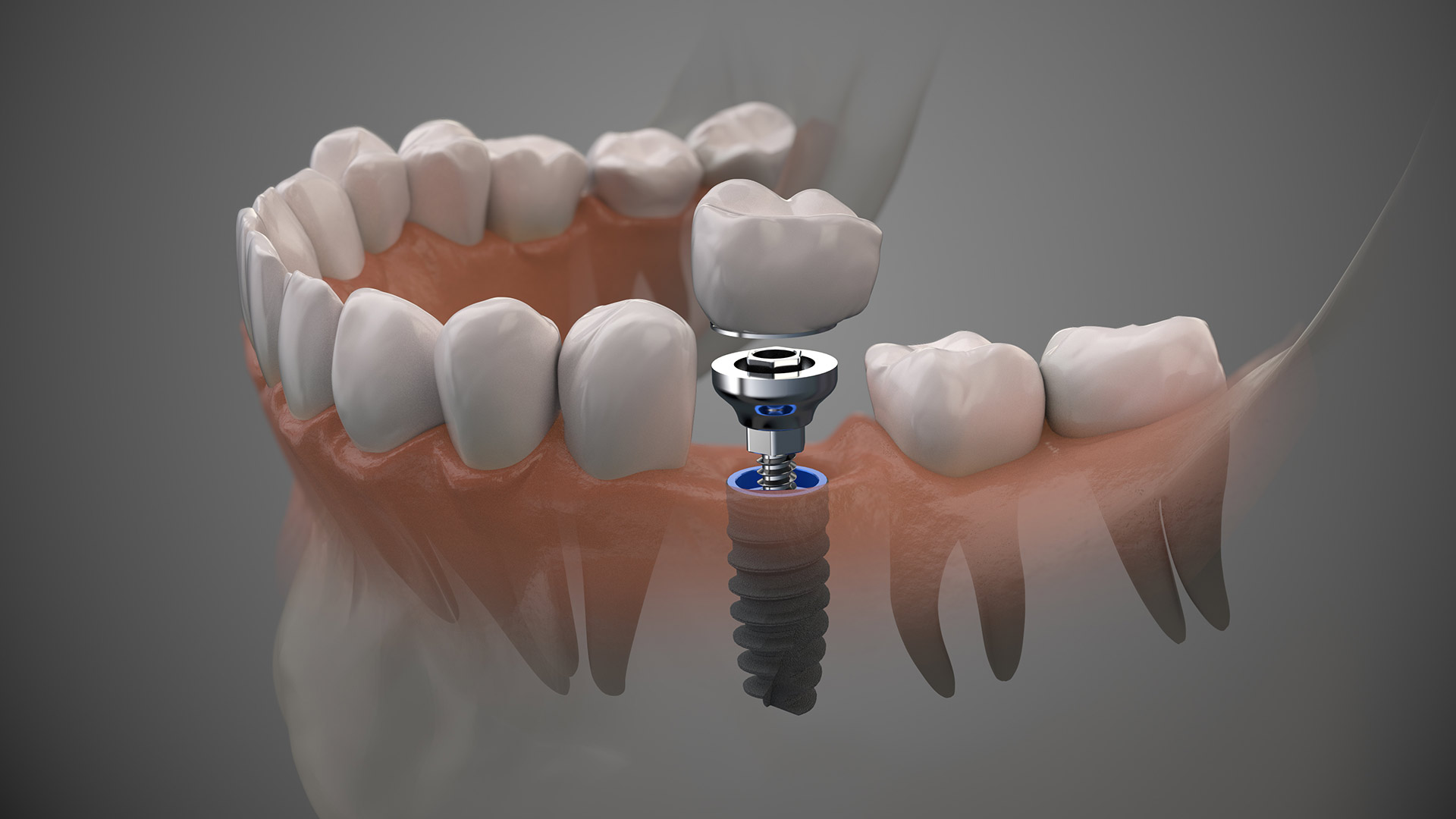
The dental implant is a cylindrical titanium construction that is placed by the surgeon inside the bone of the upper or lower jaw (most often, under local anesthesia thus ensuring its safe and fast placement and minimizing post-operative complications), and replaces the root of the lost tooth. The specially treated titanium surface of the implant “embraces” the bone, creating within the next 4 to 6 months a bond with it (osseointegration) which is the main mechanism that ensures the longevity of the final work.

After the implant is exposed, a procedure almost similar to that of the classic prostho is followed for the restoration of the tooth crown. The abutment is placed on the implant which is a metal construction made of titanium that resembles a prepped tooth. After taking the final impression and send it to the lab, the prosthetic restoration (crown-bridge-denture) is made and placed on the abutment.

Periontology
Specialty of Dentistry that deals with the diagnosis and treatment of periodontal diseases, meaning the tissues that hold the teeth in the jaws (gums, bone, alveolar bone and periodontal ligament).
Periodontal diseases include gingivitis and periodontitis.

Gingivitis: Inflammatory disease on the surface of the gums, characterized mainly by edematous red gums that bleed on their own, but also during brushing. The main cause is the lack of oral hygiene which results in the retention of dental plaque in the gums and its transformation into tartar (stone) within 2-3 weeks. Gingivitis is a completely reversible disease, as long as it is properly treated by the dentist. The treatment first involves training the patient in proper oral hygiene and then removing the tartar in 1 session, with immediate results for cleanliness and oral hygiene. The treatment is completed by polishing the teeth and re-examining the case in a week. It is especially important after the end of the treatment to maintain the health of the gums every 6 months.

Periodontitis: Untreated gingivitis leads to the spread of inflammation below the level of the gums, where the germs gradually infect the jawbone that supports the tooth, causing the bone to become permanently degraded, the gums to recede and to form an empty space called a pocket storing more germs locally. When there is no treatment for this process we lead to gradual mobility of the teeth with a final stage – due to the intense mobility – their loss. Apart from poor oral hygiene, other aggravating factors that can contribute to the exacerbation of periodontal disease are smoking, diabetes, hormonal changes (eg pregnancy), heredity, etc. Depending on the stage of the disease, treatment is divided into conservative and surgical. Conservative treatment involves removing plaque and tartar below the level of the gums by scraping under local anesthesia and polishing the root surfaces. Here, too, training in proper oral hygiene with regular re-examination on a case-by-case basis during the period deemed necessary by the Dentist plays an important role in the success of the treatment. If conservative treatment is not sufficient to completely treat the disease, then surgical treatment is applied in order to eliminate the pockets left around the tooth, to correct the damage caused by it and to create favorable anatomical conditions for the application of effective oral hygiene. Finally, regenerative techniques are performed to create new tissues and to correct aesthetic problems that undermine the patient’s smile.
Preventive dentistry
The goal of preventive dentistry in adults is to maintain oral health in order to prevent dental or periodontal diseases, but also the early diagnosis of mucosal diseases and especially oral cancer.

In the context of preventive dentistry, the main concern of the dentist is the early diagnosis of oral diseases, the correct planning of their treatment, and the appropriate implementation strategy of the design (treatment plan).

The goal of preventive dentistry in children is to prevent gingivitis and caries first in the primary teeth and then in the secondary teeth. If one of the two diseases has already started, the goal of the prevention program is to control and eliminate it. The means at the disposal of the general dentist are the regular fluoridations, the preventive fillings, the control of the eating habits and finally the learning of proper oral hygiene, that is the way in which the child should learn to take care of his teeth daily.
Fluoridation
It is usually recommended to be done every six months in the doctor’s office. Topical application of fluoride achieves the calcification of the teeth, meaning it helps to restore a small caries that starts without the use of a wheel, as well as strengthens the material of the outer surface of the tooth against the caries.
Preventive sealants
From the age of six, when the first permanent molars appear in the mouth of children, it is recommended that the protection of these teeth be done with a thin layer of composite resin (the material of the fillings) without the use of a wheel. This layer comes and covers the holes and crevices of the teeth, meaning all those surfaces where food is trapped and from which caries begin. It is an immediate and painless procedure for the child that provides significant protection to the permanent teeth for a long time.
Prosthodontics
Prosthodontics deals with the restoration of one or more missing teeth with the aim of fully recovering the patient’s chewing ability while achieving the maximum possible aesthetics in the smile and overall lower face.

Prosthodontics is divided into Removable and Fixed.
REMOVABLE
Complete Dentures
They concern the restoration of the appearance, speech and closure of the teeth of patients who have lost all their teeth, either in one or both jaws. By studying the patient’s face and taking the necessary measurements (vertical dimension, dental arch, size, shape and color of teeth) we can capture a complete in function and appearance dental block. Due to the normal absorption of the oral tissues over time, the Implanted Complete Dentures on Implants come to solve the problem of reduced retention that the total dentures present in general (especially those of the lower jaw).
Partial Dentures
Prosthodontics
They concern the structures that are based on a certain number of teeth and at the same time sit in the oral mucosa. They consist of two parts that are joined together, the metal frame and the acrylic part in which the missing teeth are placed. They are held in the mouth by special metal hooks which are in contact with the remaining teeth. Also, instead of hooks, precision connectors can be used, which fasten on crowns that have been placed on the remaining teeth, offering maximum stability in the construction and high aesthetics in the patient’s smile.
FIXED
Includes crowns and bridges on natural teeth but also on implants
Crowns
The dental crown imitates the shape of a tooth. It is applied by prepping the tooth in cases where its crown has been damaged due to extensive caries or is endodontically treated (root-canal) and needs to be strengthened in the chewing forces for protection against future fracture, or to aesthetically improve its appearance and color.
Bridges
The bridge is a prosthetic work, which replaces one or more missing teeth in the mouth. It rests on the remaining adjacent teeth which are joined together by pontics. In other words, to replace the empty space due to the lack of a tooth, we place a three-piece bridge consisting of two crowns and a pontic.

When the patient does not want to have his adjacent teeth prepped that dont include fillings or endodontic treatments, then dental implants (titanium metal structures) can be used, which after a surgical procedure and a period of time are integrated into the jaw bone and function like our natural teeth.
Posts and Core: They are placed inside the root of a tooth, as long as it has been preceded by endodontic treatment (root canal) due to the destruction of most of its crown, serving to hold the restorative material. They are distinguished in customized and prefabricated. The customized ones are divided into metal and ceramic, and the prefabricated ones into non-metallic, (Zirconia, ceramic, carbon fibre and fiberglass) and metal. The type of post and core to be placed is determined by the type of tooth and its restoration.
Oral and Maxillofacial Surgery
Oral and Maxillofacial Surgery is a specialty of medicine and dentistry that deals with the prevention, diagnosis and rehabilitation of acute and chronic diseases that occur in the oral and wider area of the face (maxillofacial area), and which may extend to the head and cervix.

These chronic conditions can be the result of disease, deformity, tumor, trauma, degeneration and aging. In particular, Oral Surgery includes the surgical pathology and surgery of the oral cavity, meaning the study of surgical techniques and pathology of diseases that are treated with surgery within the anatomical boundaries of the oral cavity. The oldest and most widespread oral surgery is tooth extraction. Other examples are the treatment of enclosed teeth, cysts, abscesses, etc.


